
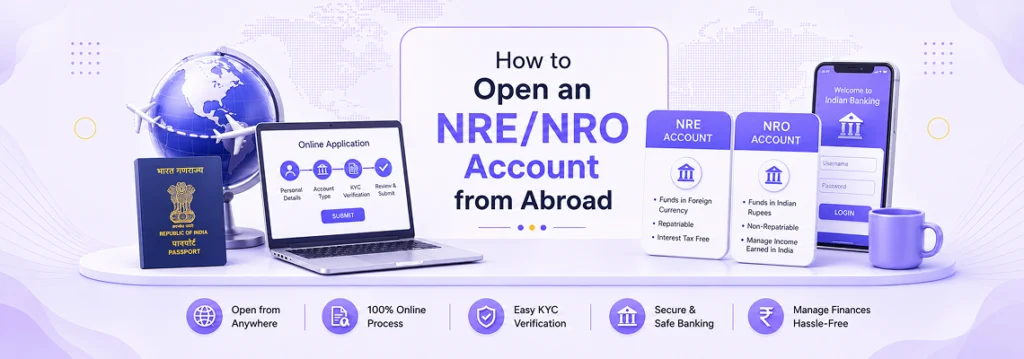
Every NRI investment in India starts with one thing: the right bank account. Without an NRE or NRO account, you can’t route mutual fund investments, receive rental income, hold Indian fixed deposits, or repatriate funds back to your country of residence.
The good news is you don’t need to fly to India to open one. Most major banks now allow NRIs to open NRE and NRO accounts from abroad, through online applications, video KYC, or their overseas branches and partner exchange houses. The process has become significantly smoother in the last few years.
The bad news? The documentation requirements vary by bank, the attestation rules differ by country, and small errors in your application can delay the process by weeks. This guide covers exactly what you need, what to watch out for, and how we help NRIs get it right the first time.
NRE vs NRO: A Quick Refresher on Which You Need
Before you open an account, you need to know which type suits your situation. “NRE vs NRO, which account to use for investments“
An NRE (Non-Resident External) account is for parking your overseas earnings in India. You send money from your salary abroad, it gets converted to rupees, and sits in an NRE account. The interest is completely tax-free in India, and both principal and interest are fully repatriable, you can move the money back abroad anytime, no cap, no questions.
An NRO (Non-Resident Ordinary) account is for managing income earned within India, rent from property, dividends from Indian shares, pension, or maturity proceeds from Indian investments. NRO interest is taxable in India (TDS at 30% plus cess), and repatriation of funds from NRO is capped at USD 1 million per financial year after taxes and documentation.
Most NRIs need both. NRE for sending money to India and investing. NRO for collecting income that originates in India.
Documents You'll Need to Open an NRE/NRO Account
The core documents are standardised across banks, though each bank may have slightly different formatting requirements:
Valid Indian passport. Pages showing your name, photograph, date of birth, signature, and importantly, the pages showing issue and expiry dates. Some banks also ask for the pages with your latest entry and exit stamps.
Overseas address proof. This varies by country but generally includes a utility bill (electricity, gas, water, not older than 3 months), a bank statement from your overseas bank (not older than 3 months), a tenancy or lease agreement, or a government-issued ID showing your foreign address (such as a US state ID, Emirates ID, Singapore NRIC, or UK residence permit).
PAN card. Required for all NRI accounts. If you don’t have one yet, you can apply online through NSDL, the process takes about 2–3 weeks. Some banks accept Form 60 as an interim alternative, but having a PAN card is essential for any investment activity, tax filing, or KYC validation.
Passport-size photographs. Typically 2–4, depending on the bank.
FATCA/CRS self-declaration form. This is mandatory for all NRI accounts. You’ll declare your country of tax residence and provide your tax identification number (SSN for US, SIN for Canada, TFN for Australia, UTR for UK, etc.). For US-based NRIs, this triggers additional reporting obligations, something to be aware of.
Visa or residency proof. A valid work visa, residency permit, or employment letter confirming your overseas status.
How to Open the Account Without Visiting India
There are three main routes, depending on your bank and location:
Route 1: Online application with video KYC. Most major private banks now offer video KYC, you fill the application online, upload documents digitally, and complete identity verification through a video call with a bank representative. The account can be activated within 3–7 working days. This is the fastest and most convenient option.
Route 2: Through the bank’s overseas branch or partner. Banks with international presence (or exchange house partnerships in the Gulf) allow you to walk into their overseas office, submit your application in person, and have it processed through their India operations. This is common in the UAE, UK, US, Singapore, and Canada. SBI, for example, offers instant NRI account facilities through its representative offices in the UAE and exchange house partners in Oman.
Route 3: Courier-based application. You download the application form from the bank’s website, fill it out, attach self-attested and notarised copies of your documents, and courier everything to your preferred home branch in India. This is the traditional route, slower (2–4 weeks), but works for banks that don’t offer video KYC or if you’re in a country without an overseas branch.
Important: For Routes 1 and 3, document attestation rules apply. If you’re not appearing in person, most banks require your documents to be attested by an Indian Embassy or Consulate, a notary public in your country of residence, or an official of a bank in your overseas country (typically a branch manager). The specific requirement varies by bank, always confirm before sending.
The Resident Account Conversion Requirement
This is a compliance point many NRIs overlook, and it can become a serious problem.
Under FEMA (Foreign Exchange Management Act), once you become an NRI, you are legally required to convert your existing resident savings account into an NRO account or close it. You cannot continue operating a regular Indian savings account as an NRI. Fixed deposits and recurring deposits must also be converted to NRO deposits.
This isn’t optional. Continuing to use a resident account after your status changes is a FEMA violation that can attract penalties of up to three times the amount involved. “NRI investment mistakes that cost real money“
If you’re opening a fresh NRE/NRO account, inform the bank about any existing resident accounts, they’ll guide you through the conversion process simultaneously.
Country-Specific Nuances That Trip NRIs Up
The account opening process isn’t identical for NRIs in every country. A few specifics worth knowing:
US and Canada: FATCA compliance adds an extra layer. US-based NRIs must provide their SSN and will be subject to reporting under the Foreign Account Tax Compliance Act. Some smaller Indian banks have restricted or stopped accepting US/Canada NRI applications due to FATCA compliance costs, you’ll generally find it easier with larger private and nationalised banks that have dedicated NRI desks.
UAE and Gulf countries: Often the smoothest experience, thanks to large NRI populations and established bank partnerships with exchange houses. Emirates ID is widely accepted as overseas address proof. Many banks offer walk-in account opening through their Gulf partners.
UK, Australia, Singapore: Standard process via video KYC or courier. UK residence permits, Australian TFN, and Singapore NRIC are accepted as overseas address and ID proof by most banks.
Attestation for documents: In the US, notarisation is straightforward through any licensed notary public. In the UK, you may need a solicitor or notary. In the UAE, documents attested by the Indian Consulate or a UAE bank official are accepted. Always check with your specific bank before getting documents attested, incorrect attestation is one of the most common reasons for application rejection.
How We Help NRIs Open the Right Account
We work with both leading private and nationalised banks to help NRIs open NRE and NRO accounts without the back-and-forth. Here’s what that looks like in practice:
We review your situation, which country you’re in, what income sources you have in India, and what you plan to invest in, and recommend the right account structure (NRE, NRO, or both). We prepare your document checklist based on your specific bank and country combination, flag any attestation requirements upfront, and coordinate with the bank’s NRI desk to ensure your application is processed smoothly.
No chasing branches. No rejected applications because of a missing stamp. No guessing which bank works best for your country.
If you’re ready to get your accounts set up, or if you already have them and want to start putting them to work, we’re here to help. “the step-by-step process for NRIs to start investing“
Common Questions About Opening NRE/NRO Accounts from Abroad
Can I open an NRE account without visiting India?
Yes. Most major banks allow fully remote NRE account opening through video KYC, overseas branches, or courier-based applications. You don’t need to be physically present in India. The process typically takes 3–7 working days for video KYC and 2–4 weeks for courier applications.
Do I need a PAN card to open an NRE/NRO account?
A PAN card is required for most NRI banking and investment activities. Some banks allow you to open an account using Form 60 as an interim measure, but you’ll need a PAN card for investments, tax filing, and full KYC validation. You can apply for a PAN card online through NSDL from anywhere in the world.
Can OCI/PIO cardholders open NRE and NRO accounts?
Yes. Overseas Citizens of India (OCI) and Persons of Indian Origin (PIO) are eligible to open both NRE and NRO accounts under RBI regulations. The document requirements are similar to those for NRI Indian passport holders, with the addition of your OCI/PIO card.
What happens to my existing Indian savings account when I become an NRI?
Under FEMA, you must convert your resident savings account to an NRO account or close it once you become an NRI. Continuing to operate a resident account as an NRI is a FEMA violation. Fixed deposits and recurring deposits must also be converted. Inform your bank about your change of status as soon as possible.
Can I hold both NRE and NRO accounts at the same bank?
Yes, and most NRIs do. NRE for parking overseas earnings (tax-free interest, fully repatriable) and NRO for managing Indian income (rent, dividends, pension). Having both at the same bank simplifies fund transfers between them and makes net banking management easier.
Disclaimer: This blog is for informational purposes only and should not be construed as financial, tax, or legal advice. Banking regulations and account requirements are subject to change. Readers are advised to confirm current requirements directly with their chosen bank. The information presented here is based on publicly available data as of the date of publication.