If you’re an NRI with any income in India, interest on your NRO account, rent from a property you own, dividends from shares, or gains from selling an asset, a chunk of that income never reaches you. It’s deducted before you even see it.
That deduction is TDS, or Tax Deducted at Source. And for NRIs, the rates are significantly higher than what resident Indians face.
The good news? You don’t have to accept every rupee deducted as final. There are legitimate ways to reduce TDS, claim refunds, and keep more of your Indian income. But you need to understand how the system works first.
What Is TDS and Why Does It Matter More for NRIs?
TDS is exactly what it sounds like, tax taken out at the source, before income is paid to you. The person or institution paying you (your bank, your tenant, the buyer of your property) deducts a percentage and deposits it directly with the Indian government on your behalf.
For resident Indians, TDS rates are relatively modest,10% on most income types, with threshold exemptions below which no TDS applies.
For NRIs, the picture changes dramatically. Under Section 195 of the Income Tax Act, any payment made to a non-resident that is taxable in India attracts TDS, often at 30% or higher, with no minimum threshold. That means even a small amount of NRO interest or a month’s rent triggers a deduction from the very first rupee.
This is the single biggest difference: resident Indians get exemption thresholds and can submit Form 15G/15H to avoid TDS entirely if their income is below the taxable limit. NRIs cannot use Form 15G or 15H at all.
TDS Rates for NRIs: A Complete Breakdown
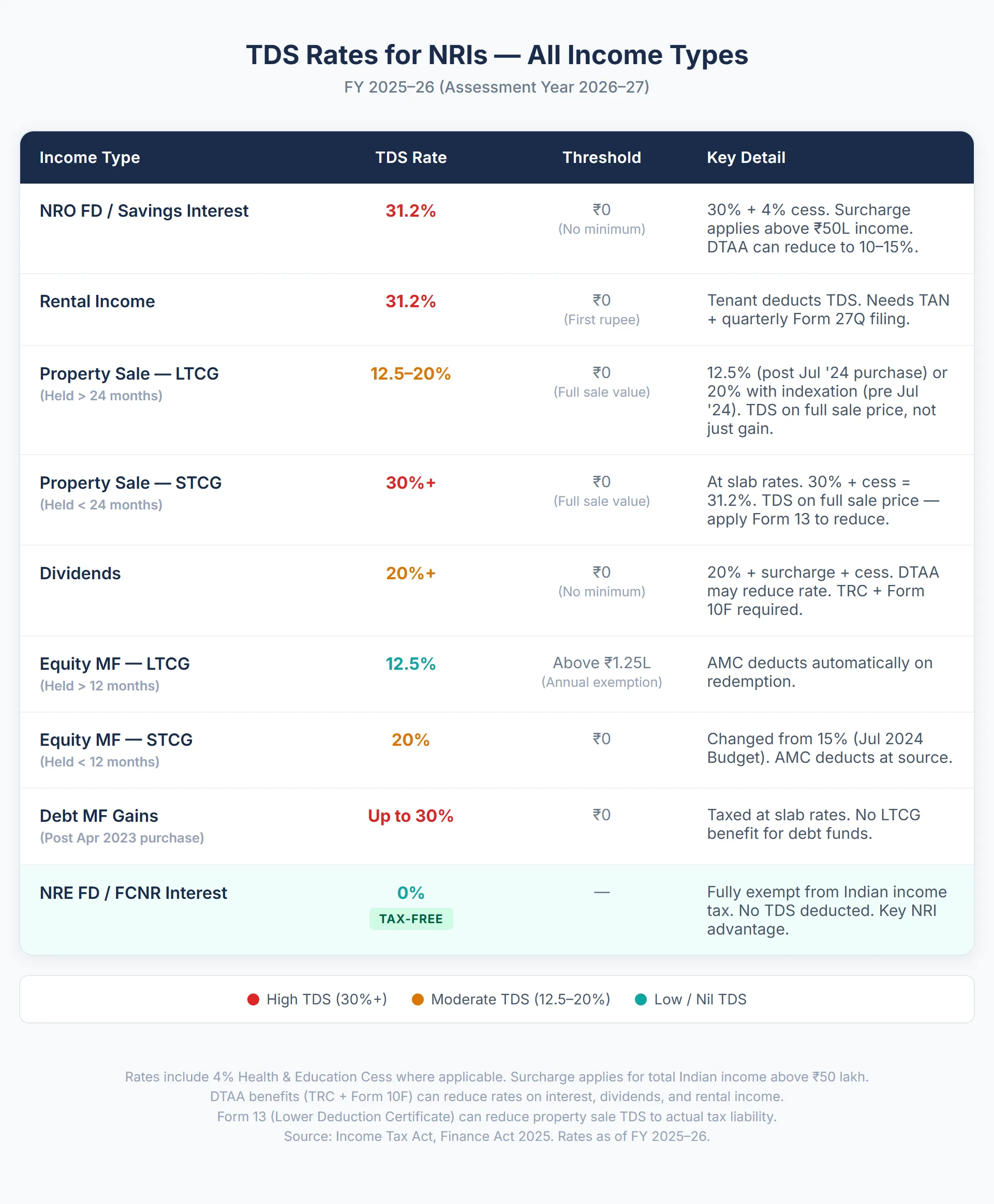
Here’s what gets deducted across your major Indian income sources as of FY 2025–26:
NRO account interest (savings and fixed deposits): 30% plus 4% health and education cess, effective rate of 31.2%. If your total Indian income exceeds ₹50 lakh, surcharges push this even higher (up to 42.74% for income above ₹5 crore). Your bank deducts this automatically every time interest is credited.
Rental income from Indian property: Your tenant must deduct 31.2% TDS (30% + cess) on the full rent, from the very first rupee. There is no exemption threshold. Your tenant also needs a TAN (Tax Deduction Account Number) and must file quarterly TDS returns using Form 27Q.
Sale of property: The buyer deducts TDS on the entire sale consideration, not just your profit. For long-term capital gains (property held over 24 months), the rate is 12.5% on gains for properties purchased after July 2024, or 20% with indexation for those purchased before. For short-term gains, it’s 30%. The critical issue? TDS is calculated on the full sale value, which almost always means far more tax is withheld than you actually owe. On a ₹1 crore property sale, the buyer might withhold ₹20 lakh, even if your actual capital gain and tax liability is only ₹3–4 lakh.
Dividends: 20% TDS plus surcharge and cess. This applies to dividends from Indian companies and mutual fund distributions.
Mutual fund redemptions: TDS is deducted automatically by the AMC. Equity fund STCG attracts 20%, equity LTCG attracts 12.5%, and debt fund gains are taxed at up to 30%. We’ve covered the complete mutual fund TDS framework in our detailed guide on how mutual funds are taxed for NRIs.
NRE account interest: Completely tax-free. No TDS applies. This is one of the most significant tax advantages available to NRIs and a key reason account structure matters, something we explore in depth in our guide on NRE vs NRO accounts.
Worried about how much TDS is eating into your Indian income? Our team helps NRIs get the right account structure in place and coordinate tax documentation, so you’re not leaving money with the tax department unnecessarily. Talk to us.
Why NRIs Often Overpay, and How the Refund Process Works
The core problem is simple: TDS is a blunt instrument. The payer deducts tax at the maximum applicable rate because they don’t know your full financial picture. They don’t know your total Indian income, your deductions, or whether a DTAA applies.
The result? Most NRIs have more TDS deducted than their actual tax liability.
The only way to get this excess back is to file an Indian income tax return (ITR-2 for NRIs) after the financial year ends. When you file, you calculate your actual tax liability, claim credit for all TDS already deducted (visible in your Form 26AS on the Income Tax portal), and the difference is refunded to your NRO account.
This is not optional, if you want your money back, you must file. And the refund can take several months to process.
This is exactly why we emphasise ITR filing as a non-negotiable step in our NRI pre-investment checklist. Without filing, excess TDS stays with the government indefinitely.
Two Ways to Legally Reduce TDS Before It's Deducted
Rather than overpaying and waiting months for a refund, NRIs have two proactive tools:
DTAA Benefits, Reduced Rates Under Tax Treaties
For example, under certain DTAAs, TDS on interest income can drop from 31.2% to as low as 10–15%. Some countries like UAE, France, and Germany even have 0% treaty rates on specific income types.
To claim DTAA benefits, you need to provide three documents to the payer (your bank, tenant, or fund house) before the income is paid: a Tax Residency Certificate (TRC) from your country of residence, a completed Form 10F (self-declaration), and a declaration confirming you’re the beneficial owner of the income.
The timing matters. You can’t claim DTAA benefits retrospectively for the same financial year. Submit these documents at the start of the year, before interest is credited or rent is paid.
Lower Deduction Certificate (Form 13), Pay Only What You Owe
If your actual tax liability on Indian income is lower than the standard TDS rate, which it almost always is for property sales, you can apply for a Lower Deduction Certificate under Section 197.
You file Form 13 on the TRACES portal, providing details of the transaction, your estimated income, and your projected tax liability. The Assessing Officer reviews it and, if satisfied, issues a certificate specifying the reduced TDS rate. The process typically takes 30–45 days.
This is especially critical when selling property as an NRI. Without this certificate, the buyer deducts TDS on the entire sale amount at 20–30%, potentially locking up lakhs of rupees that could take over a year to recover as a refund. With the certificate, TDS aligns to your actual capital gains, and far less money gets stuck with the tax department.
Budget 2026 has simplified the Form 13 process for smaller taxpayers, making this tool even more accessible.
Planning to sell property in India, or earning significant rental or interest income? Our team handles the DTAA documentation and Form 13 applications so you don’t overpay, and don’t have to chase refunds later. Let’s set it up.
The Three Things Every NRI Should Do About TDS
First, get your account structure right. NRE account interest is tax-free. NRO interest is taxed at 31.2%. If you’re parking overseas earnings in an NRO account when they could be in NRE, you’re paying unnecessary tax.
Second, submit DTAA documents proactively. Don’t wait until TDS has been deducted. Provide your TRC, Form 10F, and beneficial ownership declaration to every payer at the beginning of the financial year.
Third, file your Indian ITR every year, even if your Indian income seems small. This is the only mechanism to claim excess TDS back. And it builds a clean tax record that makes future Form 13 applications faster and smoother.
TDS doesn’t have to be a silent drain on your Indian income. With the right structure, documentation, and professional coordination, you keep what you’ve earned, and the tax department gets only what’s actually owed.
We help NRIs across the US, UK, UAE, Australia, Canada, and Singapore get their Indian tax structure right, from account setup and DTAA documentation to annual ITR filing and TDS optimisation. If you’d like us to review your current position, reach out to our team. There’s no cost for the initial conversation.
Frequently Asked Questions
Disclaimer: This blog is for informational purposes only and does not constitute tax, legal, or financial advice. Tax rates and regulations are subject to change. NRIs are advised to consult a qualified tax professional for advice specific to their individual circumstances. Mutual fund investments are subject to market risks, read all scheme-related documents carefully before investing. We specialise in Indian tax and investment planning; for tax obligations in your country of residence, please consult a local tax advisor.