
Mutual Funds

Can NRIs Invest in Mutual Funds in India? Everything You Need to Know (2026)

May 4, 2026
Can NRIs Invest in Mutual Funds in India_ Everything You Need to Know

Table of Contents

It’s the most Googled question in NRI finance — and the short answer is yes. NRIs can absolutely invest in Indian mutual funds.
But the real answer is more nuanced than that, and the nuance is where most NRIs either get stuck or make costly mistakes. Your country of residence, the type of bank account you use, and whether you’re in the US or Canada all change how this works — and sometimes whether it works at all.
This guide covers the full picture: who’s eligible, what restrictions apply (and where), how mutual funds are taxed for NRIs, and what it actually takes to get started from abroad.

Who Is Eligible to Invest in Indian Mutual Funds?

Any individual classified as a Non-Resident Indian (NRI), Overseas Citizen of India (OCI), or Person of Indian Origin (PIO) under FEMA (Foreign Exchange Management Act) can invest in Indian mutual funds.

In simple terms: if you’re an Indian citizen living abroad, or hold OCI status, you’re eligible. There’s no restriction on the types of funds you can invest in — equity, debt, hybrid, index funds, ELSS — everything is open to NRIs, with the same fund options available to resident Indians.

However, eligibility and access are two different things. And this is where things get important.
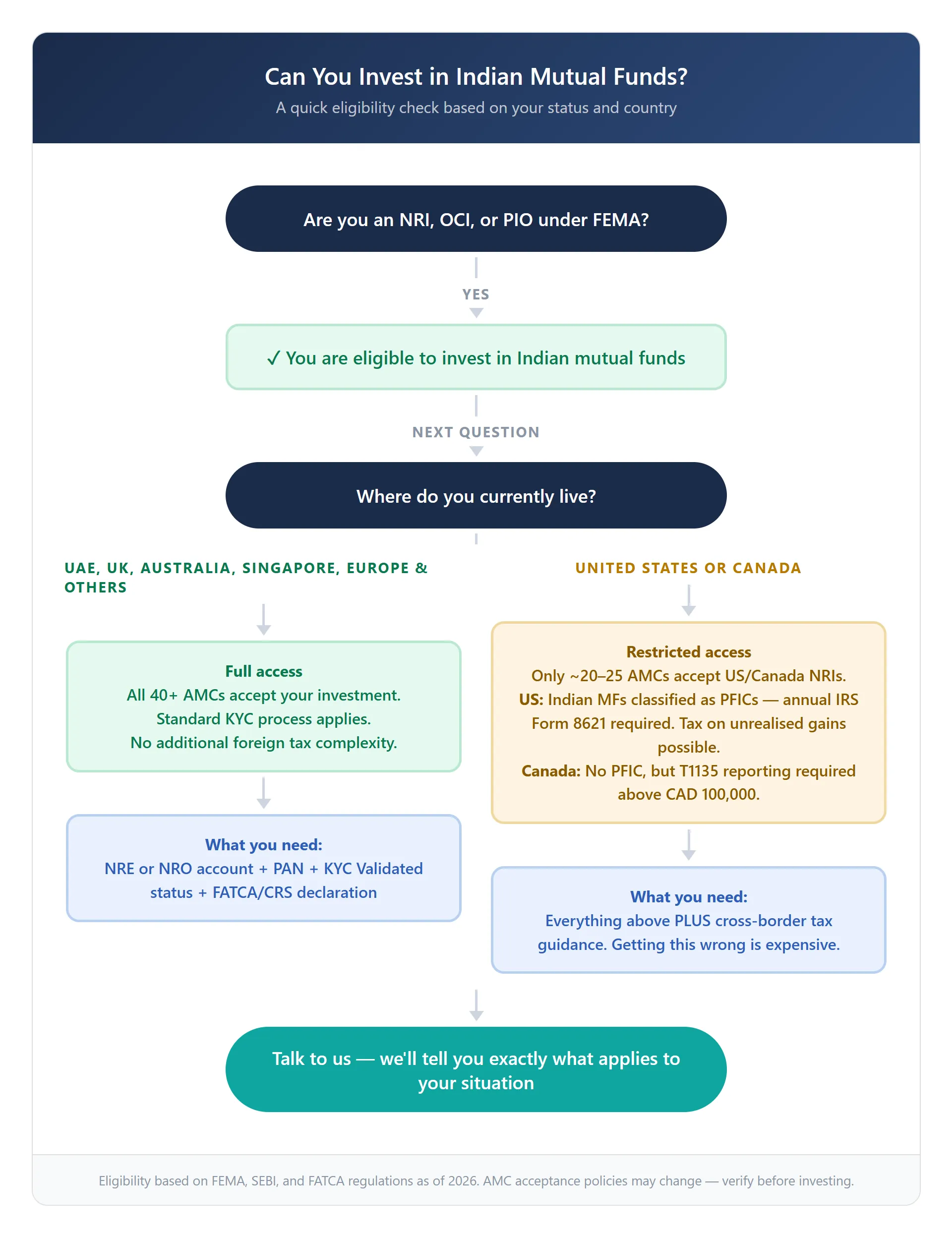
Can You Invest in Indian Mutual Funds

The US and Canada Restriction — This Matters More Than Most NRIs Realise

If you’re based in the US or Canada, your options are significantly more limited — and the tax implications are genuinely complex.

Here’s why: FATCA (Foreign Account Tax Compliance Act) requires Indian financial institutions to report the accounts and holdings of US persons to the IRS. The compliance burden this creates has led many Indian Asset Management Companies (AMCs) to simply stop accepting investments from US and Canada-based NRIs altogether.
As of 2025–2026, only around 20–25 AMCs out of 40+ in India accept investments from US and Canada NRIs. The rest have closed their doors to avoid FATCA reporting obligations.
But the bigger issue for US-based NRIs isn’t access — it’s taxation. Indian mutual funds are classified as PFICs (Passive Foreign Investment Companies) under IRS rules. This means you’re required to file an IRS Form 8621 for every single Indian mutual fund you hold, every year — even if you haven’t sold anything. And the default PFIC tax treatment is punitive: you can be taxed on unrealised gains, meaning if your mutual fund portfolio goes up by ₹10 lakh in a year, you may owe the IRS approximately 30% of that gain even though you haven’t redeemed a single unit.
This catches many US-based NRIs completely off guard.
Canadian NRIs have it somewhat easier — the PFIC concept doesn’t apply in Canada — but Indian investments above CAD 100,000 must be reported on the T1135 Foreign Income Verification Statement with annual tax filings.

This is exactly why we strongly recommend talking to us before investing if you’re based in the US or Canada. The rules are complex, the penalties for non-compliance are severe, and the right approach depends entirely on your specific situation. We help US and Canada NRIs navigate this properly — including identifying which AMCs accept your investment and how to structure things to minimise cross-border tax complications. “US-based NRI investing guide”

How NRI Mutual Fund Investing Actually Works

For NRIs outside the US and Canada, the process is more straightforward — but there are still important details to get right.

You Must Invest Through an NRE or NRO Account

Mutual funds in India can only be purchased in Indian Rupees. You cannot invest in foreign currency. This means you need an Indian bank account — specifically an NRE or NRO account. “NRE vs NRO account

The account type you use has real implications:

Investing through an NRE account means your investment proceeds are fully repatriable — when you redeem, you can send the money back abroad freely. This is the route most NRIs prefer.

means your investment proceeds are fully repatriable — when you redeem, you can send the money back abroad freely. This is the route most NRIs prefer.

Investing through an NRO account means repatriation is capped at USD 1 million per financial year across all NRO accounts, and you’ll need Form 15CA/15CB for transfers above certain thresholds.

KYC Must Be "Validated" Status

SEBI now requires all mutual fund investors — including NRIs — to have KYC “Validated” status. An older “Registered” KYC is no longer sufficient for new investments. The validation process involves additional identity verification, and for NRIs, the documentation requirements differ based on your country of residence.

This is one of the areas where NRIs face the most delays and rejections. The attestation requirements, document formats, and In-Person Verification rules vary by country — and SEBI’s norms have been evolving since 2024. We handle KYC for NRIs across 30+ countries and know exactly what each jurisdiction requires.

FATCA and CRS Declarations Are Mandatory

Regardless of your country, you’ll need to submit FATCA and CRS (Common Reporting Standard) self-declarations as part of your KYC. These confirm your global tax residency and allow Indian institutions to comply with international reporting requirements. It’s a one-time form, usually built into the KYC process.

Why Mutual Funds Are the Best Starting Point for Most NRIs

We’ve covered the rules — now let’s talk about why mutual funds consistently come out on top as the preferred investment for NRIs in India.

Professional management from a distance. You don’t need to track the Indian market daily, pick individual stocks, or make constant decisions from a different time zone. A fund manager does that for you.

Diversification built in. Even a single equity mutual fund spreads your money across 30–80 companies. You’re not betting on any single stock.

SIPs make it automatic. A Systematic Investment Plan lets you invest a fixed amount every month — starting from as little as ₹500 — without any manual intervention after setup. It builds discipline and benefits from rupee cost averaging over time. “how to start a SIP as an NRI

Tax-efficient for long-term holders. Equity mutual funds held over 12 months are taxed at just 12.5% on gains exceeding ₹1.25 lakh per year. Short-term gains (under 12 months) are taxed at 20%. Both rates are among the most favourable across all NRI investment options.
Scalable. You can start small and increase your SIP as your income grows. There’s no large upfront commitment required.
The Nifty 50 index — which you can access through a low-cost index fund — has delivered 11–14% CAGR over long-term rolling periods historically. Large-cap mutual funds have delivered 12–15% over 5-year horizons. These numbers comfortably outpace fixed deposits, bonds, and rental yields from real estate.

How Mutual Funds Are Taxed for NRIs

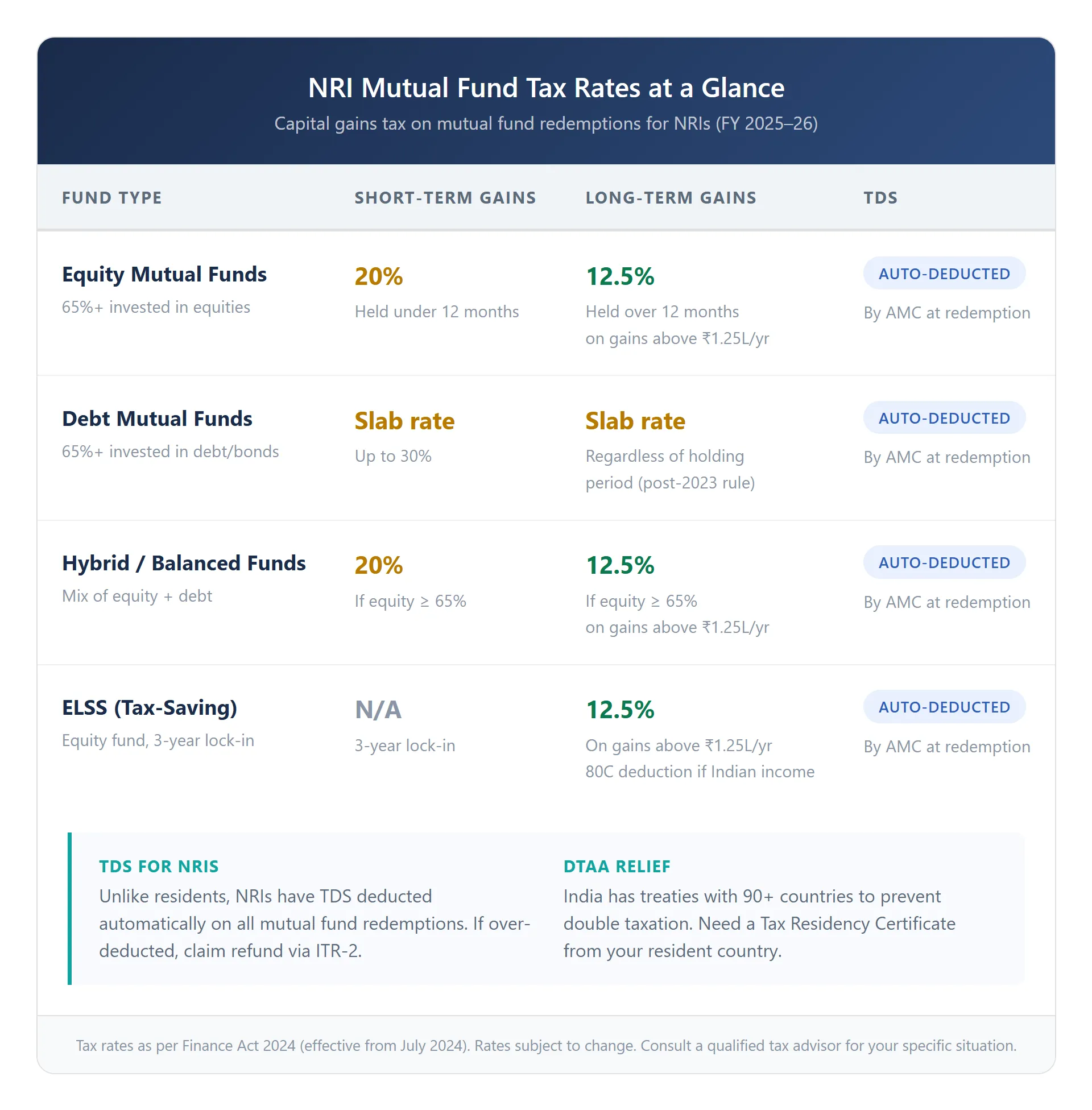
NRI Mutual Fund Tax Rates at a Glance

Tax is where mutual funds get an unfair reputation for being “complicated.” In reality, the rules are clear — you just need to know them. “NRI mutual fund taxation in detail

Equity mutual funds (65%+ invested in stocks): Short-term capital gains (held under 12 months) — taxed at 20%. Long-term capital gains (held over 12 months) — taxed at 12.5% on gains exceeding ₹1.25 lakh per year.
Debt mutual funds (65%+ invested in bonds/debt): Gains are taxed at your applicable income tax slab rate, regardless of how long you hold.
TDS is automatic. Unlike resident Indians, NRIs have TDS (Tax Deducted at Source) deducted by the fund house at the time of redemption. If the TDS deducted is higher than your actual tax liability, you can claim a refund by filing an Indian income tax return.

DTAA prevents double taxation. If your country of residence has a Double Taxation Avoidance Agreement with India (over 90 countries do), you can claim credit for taxes paid in India against your home country tax obligation. You’ll need a Tax Residency Certificate to do this.

Tax structuring is one of the areas where we add the most value. The right fund type, account type, and holding period can meaningfully reduce your tax burden — and it’s much easier to get this right at the start than to fix it later.

Common Mistakes NRIs Make with Mutual Funds

Investing through a resident account. If you haven’t converted your old savings account to NRE/NRO, any investments made through it are technically a FEMA violation. This can create compliance issues years later.

Ignoring KYC status. Many NRIs have KYC in “Registered” status from years ago. SEBI now requires “Validated” status — and your existing investments may be frozen for fresh transactions if this isn’t updated.

US NRIs not accounting for PFIC. This is the most expensive mistake. Failing to file Form 8621 can trigger IRS penalties, and the default PFIC taxation can eat into your returns significantly.
Choosing funds randomly. Picking mutual funds based on last year’s top-performer lists is a recipe for inconsistent results. Your fund selection should align with your goals, time horizon, and risk tolerance — not a ranking table.
Not reviewing after life changes. Moving countries, getting married, having children, or planning a return to India all affect your investment structure. What worked five years ago may not be right today.

Frequently Asked Questions

Yes, but with restrictions. Due to FATCA compliance requirements, only about 20–25 out of 40+ Indian AMCs accept investments from US and Canada-based NRIs. Additionally, US-based NRIs face PFIC classification, which creates complex annual IRS reporting obligations and potentially unfavourable taxation on unrealised gains. Canadian NRIs don’t face PFIC rules but must report Indian investments above CAD 100,000 on form T1135.
Yes. Most of the process — KYC, fund selection, SIP setup, and redemption — can be done online without visiting India. However, the documentation and verification requirements vary by country, and some steps may require couriered documents or embassy attestation depending on where you live.
For most NRIs, mutual funds are the better choice. They offer higher historical returns, far better liquidity, no property management hassles, and much lower entry costs. Real estate has its place, but it shouldn’t be the core of your portfolio — especially when managed from abroad. REITs offer a middle ground with property exposure and no management burden.
Yes. Equity fund gains held over 12 months are taxed at 12.5% on gains exceeding ₹1.25 lakh per year. Short-term equity gains (under 12 months) are taxed at 20%. Debt fund gains are taxed at your income slab rate. TDS is automatically deducted by the fund house at redemption. DTAA treaties with 90+ countries help prevent double taxation.
Direct plans have lower expense ratios (no distributor commission), which means marginally higher returns over time. However, regular plans come with advisory support. The right choice depends on whether you’re comfortable selecting and managing funds on your own, or whether you’d prefer guidance — which is exactly what our team provides.

Let Us Set It Up for You

Yes, you can invest in Indian mutual funds as an NRI. But between the account setup, KYC validation, country-specific restrictions, FATCA declarations, and fund selection — there’s a lot that needs to come together correctly.
That’s what we do. We handle the entire setup — from account alignment to KYC to your first SIP — and make sure everything is structured properly for your specific country and situation. No guesswork, no rejected applications, no compliance surprises down the road.

Disclaimer: This article is for informational purposes only and does not constitute financial, tax, or legal advice. Tax laws and FEMA regulations are subject to change. Mutual fund investments are subject to market risks — please read all scheme-related documents carefully. Consult a SEBI-registered investment advisor and a qualified tax professional before making investment decisions.


More Related Articles